Article ·
How to Find Your Business Direction in the Age of AI
If I wanted to build a business with AI, I would start with a problem that keeps causing me trouble—then use action and real feedback to find a direction.

Here is my starting point: if I wanted to build a business with AI, I would begin with a problem that keeps causing me trouble.
Especially one I have already spent money on, tried different ways to solve, and still have not resolved properly.
I know when it happens, how frustrating it is, and how many times I have tried to get past it. Those experiences may be the most worthwhile things I have to investigate.
If I can use AI to solve one of those problems, I will have a solution I have tested myself. I can write about the process, then look for other people struggling with the same thing.
I am my first example of a real need. The process of solving my problem becomes my first case study.
Of course, something that works for me is still a long way from being a business. I need to find out whether other people need it too, whether they want to use it, and whether they will pay for it.
But at least I have somewhere to start doing the work.
Key ideas
01 A problem can be small, but it needs to be specific enough to hurt
02 Some judgments only come from doing
03 Looking inward also takes concrete actions
01 · FOCUS
A problem can be small, but it needs to be specific enough to hurt
I want the products I build to reach a problem as precisely as the tip of a needle.
The situation may be narrow and the problem very specific, but it causes people trouble repeatedly. Ideally, they have already seriously looked for a solution, perhaps even paid for one, and are still dissatisfied.
“Use AI to help people become more efficient” is too broad a direction. That sentence alone does not tell me who to look for, or what the product would need to achieve to be useful.
If I can explain which group of people, at which point in their work, keeps getting stuck on what, it becomes easier to decide what to do next.
I have something to guide where I look for people, what I ask them, which feature I build first, and when it is ready enough for someone to try.
For example, using AI to restore old family photos, create product display images, and keep a character consistent across different pictures are three very different jobs.
Ask a little more, and the problem gets narrower still.
Does someone restoring an old photo care most about clarity, or about whether the person still looks like themselves? Where will someone creating product images publish them, and which product details are they most afraid of getting wrong?
I need to ask questions at that level before I know what I am trying to deliver.
The scope can be small. If it helps one specific person deal with a little less frustration, it is worth trying.

02 · PRACTICE
Some judgments only come from doing
I used to want to figure out my direction before I started.
Was the project promising? How would I build it? How long would it take? Where would each step lead? I wanted answers to all of it before I felt comfortable committing.
Looking back, I can see how much of that came from the habit of solving problems in school.
In an exercise, the boundaries are usually clear. The conditions are given, and an answer exists. Study it carefully enough, and you can generally find a way to solve it.
But when you start something yourself, you may not even have identified the right problem.
You think users want more features, then a conversation reveals that they are worried it will be too complicated to use. You think nobody is buying because the price is high, then discover that they never understood what the product could do for them.
That information is hard to work out while sitting at your computer.
You need to put something out there and hear specific questions and rejections before you can make a better judgment.
So I am becoming more comfortable with this: it is normal for the direction to be a little unclear at first. What matters is whether each step brings back some new information.
I need to develop my judgment through action.
03 · REFLECTION
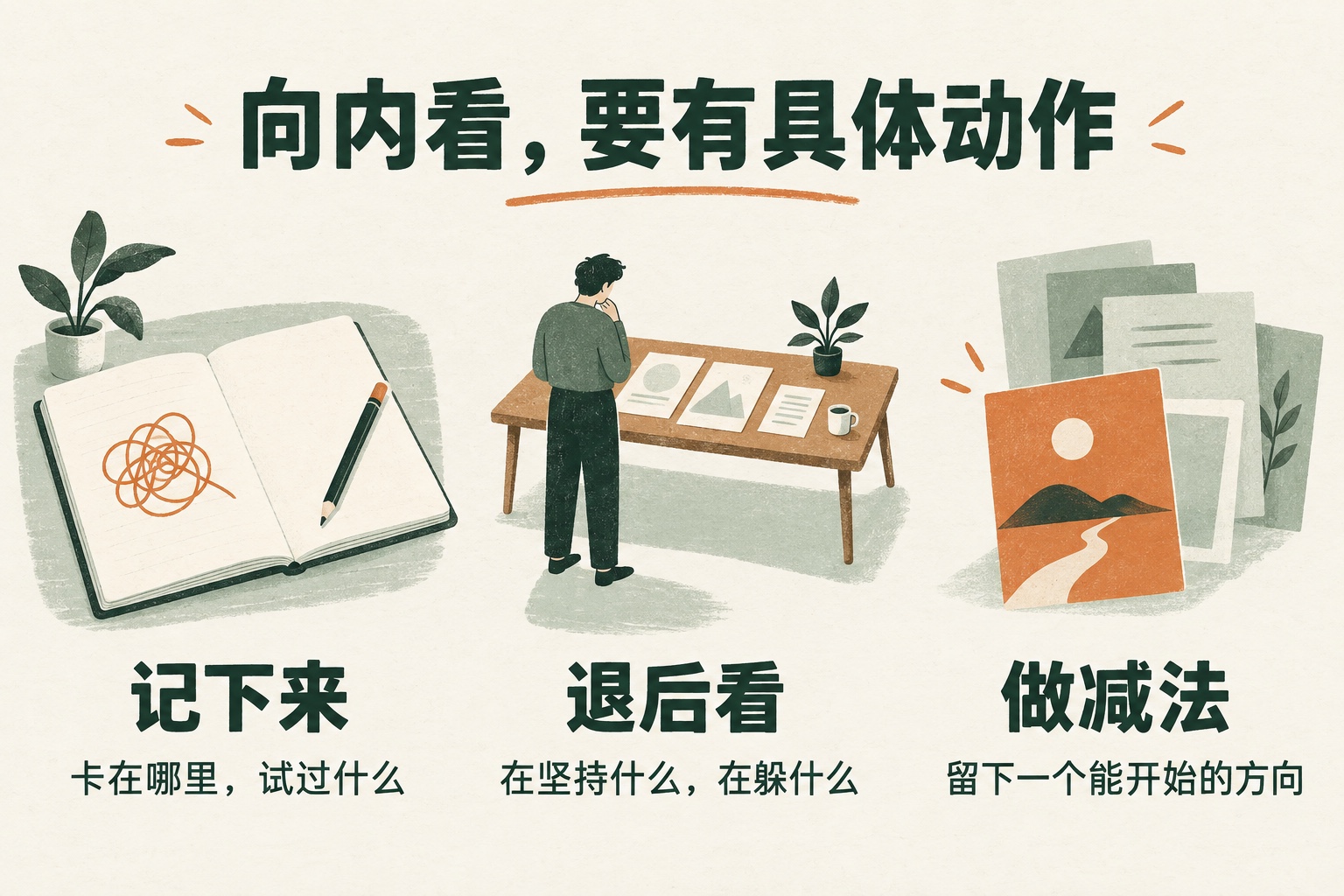
Looking inward also takes concrete actions
Starting with my own problems sounds simple. But actually doing it takes more than repeatedly asking myself, “What do I like?” or “What am I suited to?”
A few small actions help me.
Write down the things that keep bothering me.
When the same problem stops me again, when I feel anxious, or when I have spent ages on something without getting it right, I record what happened.
I try not to stop at “Today was frustrating.” I ask a few more questions:
Where exactly did I get stuck? What have I already tried? Which step takes the most time? What would I like the situation to look like instead?
Once those questions are on the page, I can separate the different things tangled up in that frustration.
Some are temporary discomforts. Some keep recurring and deserve a closer look. For others, I may already have a solution but have never properly followed through on it.
Writing helps me in that way too. Once I put something on paper, I no longer have to keep turning it over in my head just to remember it.
Step back and look at what I am doing.
I once came across a phrase that roughly means “pin yourself to the wall and take a look.” I understand it as briefly taking an observer's position and examining my own choices.
When I hit a difficulty and switch projects, how far did I actually get? Did I genuinely discover that the conditions were wrong, or did I start looking for another opportunity as soon as it became difficult?
When I finish a product but do not want to promote it, is there still a problem that affects its use, or am I afraid someone will say, “I don't need this”?
Does a new direction excite me because it builds on what I already know, or because I have not encountered its difficult parts yet?
These are uncomfortable questions, but they help me see what I am persisting with and what I am avoiding.
Set aside the directions I cannot pursue right now.
Opening a shop, e-commerce, content creation, independent software development—people have succeeded in all of them. The more I see, the harder it becomes to let any of them go.
But somebody else's result cannot simply become my starting point.
I need to look at where I already have some experience, where I can reach potential users, and what my current time and abilities would let me test through one full cycle.
If a direction requires too many missing pieces to come together at once, I can put it aside for now. Keep a few possibilities, then choose one and start.
Only by narrowing things down do I make time to move something forward.
04 · RESEARCH
Take your problem out into the world and find people like you
Finding my own pain point is only the beginning. Next, I need to look outside myself.
Wherever people look for answers, I go there to look for clues.
For physical products, I look at reviews and follow-up questions on e-commerce platforms, especially the things people remain unhappy with after buying. For content or services, I search for related problems on Douyin, Xiaohongshu, and WeChat to see how people describe their situations.
I pay particular attention to phrases that keep coming up:
“Can this solve it?”
“Is there an easier way?”
“I've tried several options, and none of them worked.”
“Can someone just help me get this done?”
These comments help me see specific people: what happened to them, what they have already tried, and what they dislike about the existing options.
Searches cannot directly prove that someone is willing to pay. But they can help me understand who else is discussing the problem, what solutions already exist, and what gap my idea might fill.

The keywords need to get more specific as I follow those clues.
Searching only for “AI” returns too much. Looking for a particular kind of person, a particular situation, or a particular desired result makes useful information easier to find.
Trend tools, keyword tools, and product research tools can help organize things. But I still need to answer a few questions myself: Who is searching? Why? What is missing from the current answers? Can I solve it?
The same goes for saving other people's projects and case studies.
After saving one, I still need to work out why it succeeded, what conditions it depended on, whether anyone is asking for that solution now, and whether I can find a small part of the problem that I could tackle myself.
Otherwise, my bookmarks keep growing while my own work stays where it is.
This research can also become ideas for content. Whatever users ask repeatedly, I can document my attempts to solve it. Finding needs, building products, and writing content begin to connect.
05 · REACH OUT
Once the product works, it is time to meet users
There is something I particularly want to remind myself here: do not get lost in building the product forever.
Using AI to turn an idea into a version someone can try is exciting. Add a feature, and the page changes. Edit some code, and a problem is solved. Every day brings visible progress.
Promotion and sales feel less comfortable.
You put something out, and nobody may respond. You explain it at length, and the other person still does not understand. You think it is already good, but people do not want to pay.
At that point, it is easy to retreat into adding more features. It feels as if someone will want it once it is a little more polished.
But users may never have seen it. Or they may have seen it without understanding what it has to do with them.
Why are they hesitant? What do they most urgently need to solve? What result would they pay for? I can only find out by getting in touch with people.
Some questions cannot be answered by adding another ten features.
So, once a product can do its core job, I am willing to spend most of my early effort—even 70 or 80 percent—on talking to users, creating content, promotion, and sales.
First, take it through one complete cycle: someone sees it, understands it, tries it, and pays; then I deliver the result I promised.

Often, when I suspect that my direction is wrong, I have not even completed that cycle.
I stop once the product is built. I publish two pieces of content, get no response, and move on. A few people turn me down, and I start looking for a project with “more potential.”
If I leave at that point every time, I never learn where things are getting stuck.
If nobody sees it, look for places where I can reach the right people. If people do not understand, change how I explain it. If they try it and it does not help, go back and improve the product.
Those specific adjustments are part of doing the work too.
06 · FEEDBACK
What can the first payment tell me?
To me, the first payment is an important piece of feedback.
It means at least one person is willing to pay for the result I have promised. That gives me a few questions worth exploring carefully:
Why did they buy? What mattered most to them? Were they satisfied after delivery? Who else is struggling with the same thing?
One sale, of course, does not prove that the whole direction is sound. I still need to see whether I can deliver consistently and find more people with similar needs. If the product or service lends itself to repeat purchases, I also need to see whether that person wants to buy again.
But I finally have something concrete to analyze.
Instead of continuing to guess whether the project will work, I would rather understand why someone was willing to buy this time and whether I can deliver the same result well next time.
The direction becomes clearer, little by little, through feedback like this.
07 · COMPOUND
What is worth more of my time?
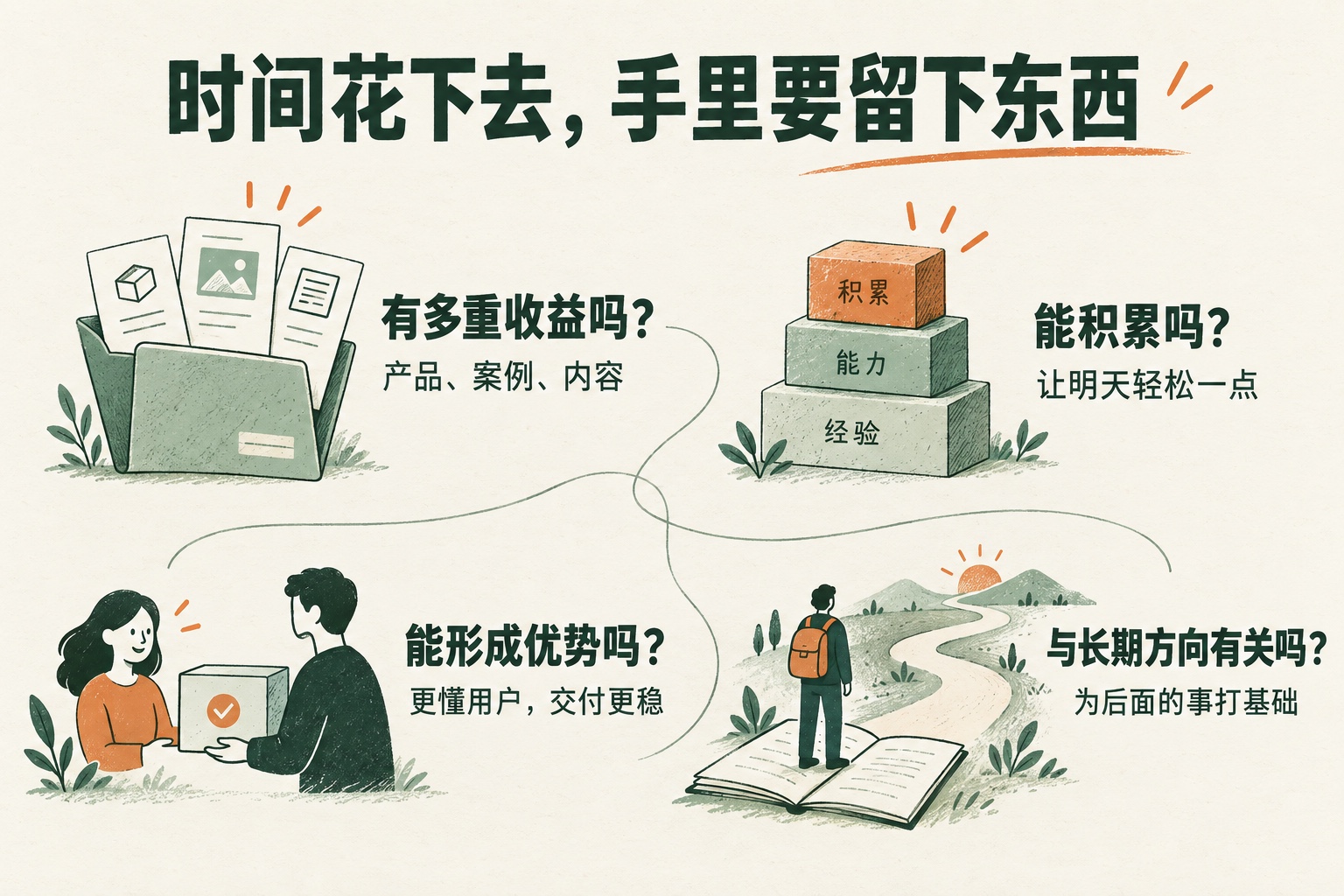
When a direction starts to show signs of promise, I use four more questions to decide whether to invest more effort.
Can one thing produce several kinds of value? After solving my own problem, could I also have a product, a case study, and content, as well as contact with potential users?
Can the work build on itself? Can what I finish today make tomorrow easier, or will I have to start from scratch every time?
Can it help me develop an advantage of my own? That might mean understanding a certain group of users better, having more case studies, or becoming more consistent at delivering results.
Does it connect with what I want to do over the longer term? Could doing this well lay some groundwork for what comes later?
I want the time I put in to leave me with something.
Seeing dozens of possible directions is gathering information. Choosing which one to try first, and which opportunities I am willing to set aside for it, is where my own judgment starts to matter.
∞ · POSTSCRIPT
Allow yourself to move slowly, and finish one full cycle first
There is one more thing I am learning: when I run into difficulties, do not rush to judge myself harshly.
If I fail to explain something clearly the first time, I can revise it. If someone is unhappy with the product, I can ask why. If an honest attempt shows that an assumption was wrong, that can still save me a detour.
If I interpret every setback as “I am not suited to this” or “I chose the wrong thing,” I will become more and more afraid to act.
When I feel anxious, I want to first look at what has actually happened: Where have I made progress? What have I not tried yet? What is the next small action I can take?
It is all right to feel impatient. But I do not want that impatience to send me back into endlessly searching for projects and methods.
I only began to feel the weight of these ideas after trying things myself. I had heard some of them many times. But when it is my turn to face silence or a lack of sales, I understand how hard they can be to follow.
So I want to write them down for myself as I am now, and for others at the same stage.
For now, I plan to choose one specific problem from the frustrations I have not resolved, and try using AI to help myself solve it. I will share the process, then reach out to people struggling with the same thing.
If someone wants to use it, I will listen carefully to their feedback. If someone wants to buy it, I will deliver the result I promised.
Eventually, I hope it can have a reliable way of finding customers and delivering results, so that every order does not require explaining everything and doing all the work from scratch. But that has to be built gradually, through real attempts.
Right now, I want to serve my first customer well.
That person is me.
END
Is there a problem that keeps bothering you—perhaps one you have even paid to solve, without success? Share it in the comments, and be as specific as you can.
The above reflects personal experience only and does not constitute investment advice.